
One of the most common questions we hear from companies evaluating AI voice agents is simple: what does it actually cost, and how fast does it pay for itself? The short answer is encouraging. The longer answer requires some honesty about what the numbers include and what they don’t.
The baseline: what a human call costs
A typical customer service call handled by a live agent costs between $6 and $12, depending on geography, complexity, and how you calculate overhead [1]. That number includes not just the agent’s salary, but benefits, training, software licences, management overhead, and facilities.
The fully loaded annual cost of a contact centre agent in a mid-sized operation is roughly $50,000 [2]. But you can’t divide that by 2,080 working hours, because agents aren’t on calls 100% of the time. Between breaks, meetings, training, and idle time, a realistic utilisation rate sits around 70% [2]. That pushes the effective cost per productive minute to approximately $0.55, or roughly $5.70 for a standard 10-minute Level 1 support call [2].
On top of that, contact centres face annual turnover rates of 40 to 45%, about twice the average of other industries [3]. Each departure costs an estimated $22,500 to $42,000 in recruiting, training, and lost productivity [3]. These costs don’t show up in per-call metrics, but they shape the total cost of running a phone-based operation.
A note on European numbers
Most published unit economics data comes from the US market. European figures vary significantly by region. Agent costs in Western Europe tend to be higher than US averages, particularly in markets like Germany, the Nordics, and Switzerland, where fully loaded agent costs can exceed €55,000 per year. Eastern European nearshore operations (Poland, Romania, Bulgaria) bring agent costs closer to $3 to $5 per call, which is the range where Gartner’s offshore comparison becomes relevant [7]. The AI cost side of the equation is largely geography-independent, since most providers price per minute or per call regardless of where the call originates. That means the cost advantage of voice AI tends to be even more pronounced in high-wage European markets, while it narrows considerably against Eastern European nearshore operations.
The AI side: what a voice agent costs
AI voice agent pricing typically ranges from $0.10 to $2.00 per minute, with most business-grade solutions priced between $0.50 and $1.50 per minute [4]. On a per-call basis, automated interactions come in at roughly $0.30 to $2.00, depending on complexity, integration depth, and provider [1].
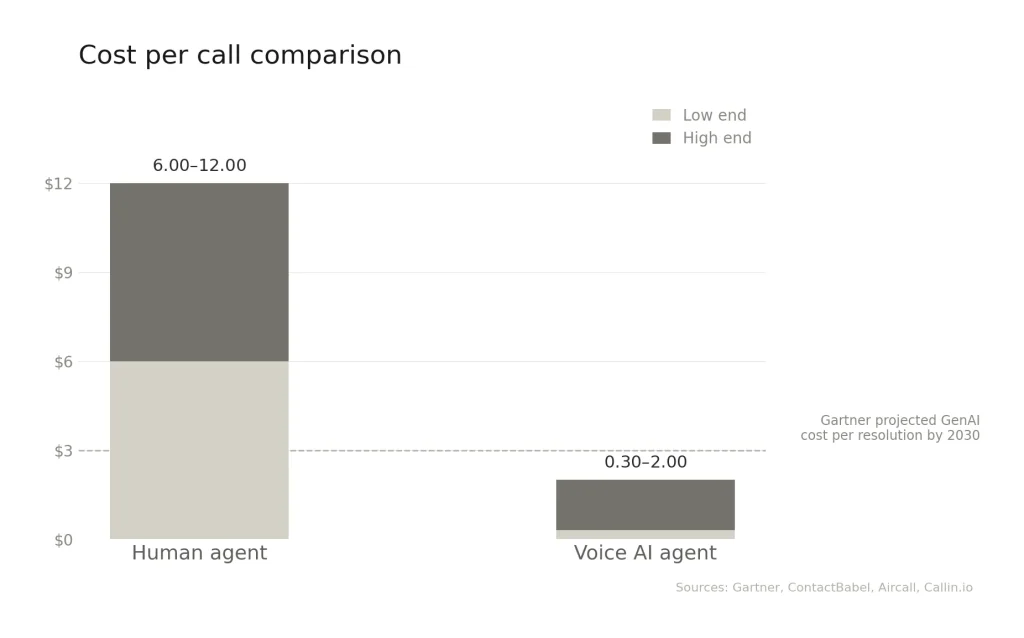
That gives you a cost reduction of somewhere between 60% and 95% per interaction compared to a fully loaded human agent [1]. Companies that have deployed voice agents at scale report measurable results. One insurance company automated 80% of inbound calls related to policy inquiries and claims, reducing its agent headcount from 200 to 60 and saving roughly $9.8 million annually, with a payback period of 3.2 months [5]. A Swiss telecom provider rebuilt its AI agent and cut operational costs by 50% while improving its net promoter score [3].
The typical ROI timeline across published case studies sits between 60 and 90 days for straightforward implementations [5]. More complex enterprise deployments with deep system integrations may take six to twelve months to show full ROI [6].
The caveats most vendors skip
These numbers are real, but they come with conditions that matter.
First, implementation isn’t free. Setup and onboarding fees typically run $500 to $2,000. Custom integrations with existing CRM or ticketing systems can add $1,000 to $5,000 [4]. Ongoing maintenance for prompt tuning and quality assurance adds further cost, estimated at around $20,000 per year for a mid-sized deployment [2].
Second, containment rate is everything. The economics only work when the AI actually resolves the call. If a voice agent handles the interaction end to end, it’s cheap. If it fails and escalates to a human, you’ve paid for both the AI and the agent. A realistic containment rate for well-implemented systems sits between 60% and 80% [6]. The gap between 60% and 80% makes a significant difference to the business case.
Third, there’s a counterpoint worth taking seriously. Gartner predicts that by 2030, the cost per resolution for generative AI in customer service will exceed $3, higher than many offshore human agents [7]. Rising data centre costs, a shift from subsidised vendor pricing to profitability, and increasingly complex use cases that consume more tokens and require expensive talent will push costs up over time [7]. A Gartner survey from October 2025 found that only 20% of customer service leaders had actually reduced agent staffing because of AI [8].
This doesn’t mean voice AI is a bad investment. It means that cost reduction alone is not always the right framing. The strongest deployments use voice agents to handle high-volume, repetitive calls where quality and availability matter more than cost per minute.
What to take from this
The unit economics of voice AI are favourable for specific, well-defined use cases. Routine Level 1 calls, appointment scheduling, order tracking, FAQ handling. For these, the cost advantage over human agents is real and measurable.
But the economics shift when calls get complex, when containment rates drop, or when you factor in the full cost of implementation and maintenance. The companies that get the best ROI from voice AI are the ones that start with a narrow, high-volume use case, prove the economics there, and expand from a position of evidence rather than assumption.
Sources
[1] Callin.io, “Average cost per call inbound call center in 2025.” March 2025. Citing Gartner and ContactBabel data. Link
[2] Sandeep Bansal, “The Honest ROI of AI Voice Agents: A Unit Economics Guide.” Medium / AI for Business Academy. December 18, 2025. Link
[3] Rasa, “How AI Voice Agents Help Control Call Center Costs.” March 4, 2026. Citing Insignia Resources data. Link
[4] Aircall, “AI voice agent pricing guide 2025: Costs, comparisons, and ROI.” September 8, 2025. Link
[5] Naitive, “Voice AI Agents: Cutting Customer Service Costs.” January 26, 2026. Link
[6] Synthflow, “Top 10 Enterprise AI Voice Agent Vendors for Contact Centers in 2025.” October 6, 2026. Link
[7] Gartner, “Gartner Predicts GenAI Cost Per Resolution for Customer Service Will Exceed Offshore Human Agent Costs by 2030.” January 26, 2026. Link
[8] CX Today, “AI Customer Service Costs Will Exceed Human Agents by 2030.” February 3, 2026. Citing Gartner survey data. Link