
Voice AI is no longer a research project. It’s a market with real revenue, aggressive growth projections, and billions in venture capital flowing in. But the numbers vary wildly depending on which segment you look at, and most market reports don’t make that distinction clearly enough. Here’s what the data actually says.
Three markets, not one
“Voice AI” is an umbrella term that covers at least three distinct segments, each with its own dynamics.
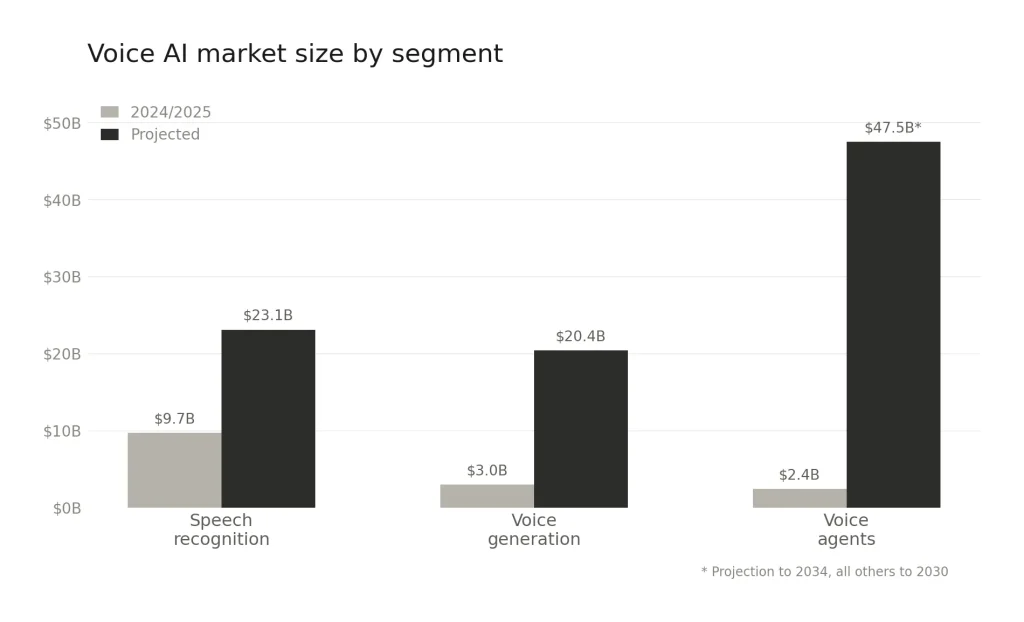
The broadest category is speech and voice recognition, the foundational layer that includes automatic speech recognition (ASR), voice biometrics, and traditional voice interfaces. This market was valued at roughly $9.7 billion in 2025 and is projected to reach $23.1 billion by 2030, growing at a CAGR of 19.1% [1]. It’s the most mature segment, driven by enterprise adoption in healthcare, banking, and telecommunications.
Then there’s AI voice generation, the TTS and speech synthesis layer that makes AI sound human. MarketsandMarkets estimates this segment at $3.0 billion in 2024, growing to $20.4 billion by 2030 at a CAGR of 37.1% [2]. Grand View Research puts the 2023 baseline slightly higher at $3.56 billion, projecting $21.75 billion by 2030 at ~30% CAGR [3]. The numbers don’t match exactly, but the direction is consistent: this segment is growing faster than recognition because it’s where the recent model breakthroughs happened.
The third and newest category is voice AI agents, autonomous systems that don’t just recognise or generate speech, but actually conduct conversations, make decisions, and complete tasks over the phone. Market.us estimates this at $2.4 billion in 2024, reaching $47.5 billion by 2034 at a 34.8% CAGR [4]. These projections should be treated as directional rather than precise, but they reflect a real shift: voice agents are where most of the new venture capital is going.
The growth is real, but uneven
Add these segments up and you get a combined market moving from roughly $15 billion today toward $80–90 billion by the end of the decade. That’s significant. But within that number, the maturity levels differ dramatically.
Speech recognition is a 20-year-old market. The infrastructure works. Growth comes from wider enterprise adoption and edge deployment, not from fundamental breakthroughs. Voice generation had its inflection point in 2023–2024 when neural TTS models became good enough for production use. Companies like ElevenLabs, which closed 2025 with over $330 million in ARR [5], proved there’s real commercial demand, not just research interest.
Voice agents are the youngest and most volatile segment. a16z noted in their 2025 update that the industry is transitioning from infrastructure to application layer, with voice becoming “the wedge, not the product” [6]. That means the market is still being defined. Use cases are emerging, pricing models are shifting, and most enterprise deployments start with a small percentage of calls rather than full replacement of human agents.
Geography matters
North America dominates, accounting for over 40% of market share across most segments [7]. That’s partly infrastructure, partly willingness to adopt. Asia-Pacific is the fastest-growing region, driven by smartphone penetration and government-backed digitalisation in China, India, and Japan [1]. Europe sits in between, strong on regulation, growing on adoption.
What to take from this
The voice AI market is real, growing fast, and increasingly well-funded. But it’s not one market. Recognition, generation, and agents each follow different trajectories, serve different buyers, and face different challenges. Companies evaluating voice AI should be clear about which layer they’re buying into, and what maturity level comes with it.
Sources
[1] MarketsandMarkets, “Speech and Voice Recognition Market – Global Forecast to 2030.” 2025. Link
[2] MarketsandMarkets, “AI Voice Generator Market Report 2025-2031, By Applications, Geo, Tech.” 2025. Link
[3] Grand View Research, “AI Voice Generators Market Size And Share Report, 2030.” Link
[4] AgentVoice, “AI voice in 2025: Mapping a $45 billion market shift.” September 2, 2025. Citing Market.us data. Link
[5] ElevenLabs, “Series D Announcement.” February 2026. Link
[6] Andreessen Horowitz (a16z), “AI Voice Agents: 2025 Update.” Olivia Moore. January 2025. Link
[7] VoiceAIWrapper, “Voice AI Market Analysis 2026 – Trends & Growth.” March 2026. Citing multiple sources. Link